Showing posts with label explain. Show all posts

Monday, May 6, 2013

What to look for in a gym...

Some have asked what to look for in a CrossFit-style gym back in the states.  Here are my recommendations:

1.  A focus on STRENGTH.  The gym should have a dedicated strength component to their programming.  At least one heavy lift each session, or regular, dedicated strength days (like an alternating ME Black Box structure).

2.  QUALITY coaching.

Credentials
A lot of CrossFit gyms are run by really nice, enthusiastic, supportive coaches who, quite frankly, have almost no clue what they’re doing.  Many CrossFit coaches have no more than a Level 1 CrossFit certification.  While some of those coaches are outstanding (because of prior or continued education and experience), many are not.  Personally, I would look for a coach who has at least one of the following credentials in addition to a CF Level 1.  These are listed in ORDER OF SIGNIFICANCE (in my opinion):

a.  Certified Strength and Conditioning Specialist (aka, CSCS - a minimum requirement for any NCAA strength and conditioning coach)

b.  Starting Strength Coach (a certification offered by Mark Rippetoe, our strength guru)

c.  CrossFit HQ Trainer designation (this means that the individual teaches at CrossFit certification seminars)

d.  any USA Weightlifting certification (these guys know the Olympic lifts better than anyone)

e.  CrossFit Level 2

As a reference, M and I have (a) and (d), in addition to our CrossFit Level 1.  I will say this: CrossFit did NOT teach us how squat, deadlift, power clean, snatch, or bench press.  Nor did they teach us how to properly coach those lifts.  We learned the “slow lifts” – and how to coach them – from Mark Rippetoe (through watching videos), and we learned the Olympic lifts – and how to coach them – from Chad Vaughn and USA Weighlifting (and hours of watching videos on the web).

Attentiveness
Ask to participate in a free class.  Better, watch a class and observe the coaching from a detached perspective.  Is the coach attentive to everyone in the room?  What’s the coach-to-athlete ratio?  Are athletes actually being coached or just encouraged?  I.e., are form corrections being made?  Are you hearing good verbal cues?

Ability to Scale/Modify Appropriately
Good gyms will have "on-ramp" programs for introducing clients to proper movement form.  You all are beyond that at this point, but a good coach should know how to scale or modify things appropriately for you.  For example, here are a few movements that you're probably not ready for yet (though a skilled coach can work you through a gradual progression once you have the requisite strength), along the modifications we'd recommend:

  • Handstand pushups:  Substitute another pushing movement, like pushpress or push-ups.  (Some might even suggest an elevated form of pushups, where your feet are up on a box, which is fine if they show you how.)
  • Ring dips:  Dips are nothing more than a downward pushing movement.  The rings make regular dips even harder, by adding in a stabilization component and requiring serious shoulder strength.  Instead, do bench dips, or better yet, push-ups.  
  • Muscle-ups:  These are for serious competitors only; it can really jack up your shoulders to try these when you're not ready.  A good coach might substitute a couple of movements like pull-ups/rows and push-ups.  

3.  A SCHEDULE that works for you.  Both time of day, but also days per week.  A lot of CrossFit gyms are set up for three days on, one day off programming.  Make sure that the gyms’s programming will work for you if you want to do MWF or T/TH/Sat.

We’re happy to check out the websites of gyms you’re considering.  If you need help anytime this summer or next year, just let us know!

Sunday, November 18, 2012

What We're Doing and Why

True fitness, in our view, requires a very wide range of abilities.  Marathoners who cannot do 100 push-ups are not fit.  Weightlifters who cannot run three miles are not fit.  We seek the broad inclusive fitness of a Navy SEAL: we want to be able to climb mountains with heavy packs, to sprint up stairs or dash a half mile for help, to pick up heavy things, carry them, or put them overhead, to pull ourselves up and over objects.  That level of fitness is a lofty goal to strive for, let alone achieve, particularly as we age.  But that’s what we want for ourselves, and that’s the way we train.  It may or may not be what you want for yourself.

To work towards this vision of broad inclusive fitness, we train broadly and inclusively.  We lift weights to get stronger, faster, and more powerful.  We do high-intensity conditioning to improve our anaerobic and short-term work capacity.  And we do longer, slower conditioning to improve our aerobic capacity and stamina.

And we train each of those areas – strength, work capacity, and stamina – using a broad, inclusive set of movements.  We do pull-ups, push-ups, and burpees.  We run, row, and jump rope.  We move barbells, dumbbells, and medicine balls.

It’s not that the running is for stamina and the barbells are for strength.  It’s more sophisticated than that.  Sprinting stairs develops strength and power.  Doing shuttle-sprint intervals improves short-duration work capacity.  Going for a long run improves our endurance.  One movement, running, is implemented in different ways to improve different aspects of fitness.  Heavy deadlifts in sets of three build strength.  Moderately heavy deadlifts (coupled with overhead press) in sets of 21, 15, and 9 – and performed as fast as possible! – build work capacity.  Doing lighter deadlifts in sets of 15, 14, 13, down to 1 as part of a 45-minute workout with lots of other movements builds stamina.  One movement implemented in different ways to improve different aspects of fitness.

So how have we structured our classes and why?

First, we assume that you can do monostructural stamina training on your own.  You can ride a bike, or go for a walk, run, or row at a steady pace for 20 minutes to an hour without us being there to watch or encourage you.  That’s why our classes focus on strength training and high-intensity conditioning.

You’re doing strength work and high-intensity conditioning with us three days per week, but we assume that you’re doing two or three days of something else.  Maybe you’re running, maybe you’re playing Ultimate, or maybe you’re just walking your dog for 45 minutes every day.  If you’re doing nothing, just realize that we, in our classes, are NOT doing much stamina work.  Michelle and I do a lot of running in our own training, and I would encourage everyone to at least walk three times per week.

We alternate the lifts (squat, overhead press, and pulling on one day; power cleans, deadlifts, and bench press on the other day) so that all of the important movements get trained, and so that you have adequate time to recover between efforts.  Our high-intensity conditioning sessions (“metcons”, short for metabolic conditioning) are thoughtfully programmed to provide you a wide-range of stimuli to force a wide-range of adaptations.  We mix gymnastic, body-weight movements with weightlifting and monostructural movements.  Sometimes they’re couplets (burpees and deadlifts), sometimes they’re triplets (rowing, swings, squats), sometimes they’re single movements (150 wall-balls, anyone?).  Sometimes they are task-limited: do this amount of work, then you’re done.  Sometimes they are time-limited: work as hard as you can for this amount of time, then stop.  Sometimes they are really heavy or really fast and hence very short.  Sometimes they’re lighter and longer.  Sometimes we give you rest during the training so that you can go harder during the work intervals (shuttle sprints, Tabatas).

There’s both a science and an art to programming the metcons, but we try to expose you to constantly varied stimuli to keep things fresh psychologically and to force broad physical adaptations.

Throw in the warm-ups, some agility work, lots of skill and technique coaching, occasionally chats about nutrition (which we should do more of!), *tons* of encouragement and well-earned praise, and that’s what we offer.

Now that you’re clear on our goals and what we’re offering and why, we want you to think about how our classes fit in with your particular fitness goals.  Some of you have recently completed half-marathon runs, some of you are thinking of competing in triathlons.  If you want to focus on running or biking or even training for a long trek, you might want to bias your training towards that goal.  For instance, it might be better for you to dedicate yourself to serious running three or four days per week, and do our class just twice per week.  (We already have two athletes who are doing this.)  If you need help planning your training beyond our class, just let us know.  We’re happy to offer advice.

Friday, November 16, 2012

The Mechanics of Hang Power Cleans

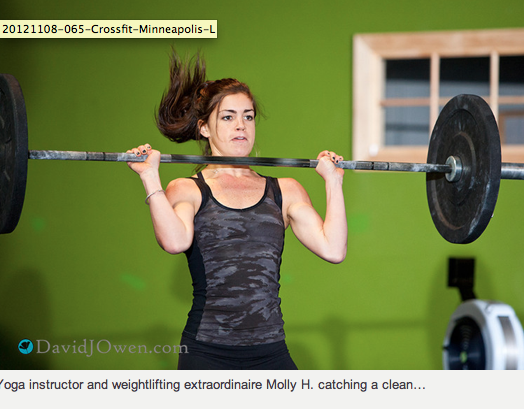
This morning I worked on my hang power cleans and I discussed with Michelle my concern about  proper mechanics. The clean is a complex movement that requires (like everything else we do here) proper set up and efficient execution. The clean goes so quickly that I am not sure if I am truly getting the hip extension before getting under the weight.  It's one thing to practice without weight and to break up to movements, such as starting in the dead lift position (weight in the heels, feet shoulder-width apart, bent knees, butt out, shoulders forward and in front of the bar, arms straight, head neutral and looking forward), getting a full hip extension, getting under the bar and keeping it close (zip it up), jumping feet out a little wider, and catching.  I find that when I add the weight, all of those elements go so fast.  So, I found three pictures from Minneapolis Crossfit, the place where I worked out last summer.  I thought I'd share the pictures.

Set up:


Hip extension:


Getting under the bar and catching:


Of course, this would have been better if the three pictures came from the same person.  Michelle posted a picture of an Olympic lifter in the three key positions of a hang in August.  You can refer back to that post, if interested.

http://facultyathlete.blogspot.in/2012/08/how-to-hang-clean-only-3-things-you.html

Thoughts?
--Skye

Tuesday, September 4, 2012

Why have we changed up the rep schemes?

Some of you may be wondering why in the world we've decided to switch up the rep scheme, making you do fewer reps in each set.  You may be thinking, "Hey, I'm not getting my money's worth here, since I'm only doing 3x3 of my favorite lift today!"  Or, "Is it really worth it to get out of bed early for 9 measly reps?"

Allow us to explain:

The volume of your training depends upon your training goal.  As you can see in this very colorful chart, when you're doing sets of 5's, you're training in the center-to-high end of the yellow band where strength is the main goal.  This is our go-to, default, preferred rep range.  The Monday-Wednesday-Friday crew is very familiar with this, and they've been working 5's for the majority of their training career so far.


What about the Tuesday-Thursday-Saturday group?  Why have we been torturing y'all with 8's?  Because our goal for you as beginners is a little bit more focused on hypertrophy (muscle growth).  We want you to get some bigger muscles first, so that later you can recruit those muscles for greater strength.  In other words, "get swole."  Also, when you're first learning the lifts, it's good to spend more time under the bar to practice and pattern the movements.  So, you can see that your 8's put you in the range that will lead to this particular goal.

Now, after the first month of training, we'd like you to start using some heavier loads in order to increase the intensity and force your system (nervous, muscular, endocrine, skeletal, etc.) to adapt and grow.  So, the MWF will spend the next couple weeks working in the 3's. The TThS crew will drop down to 5's.  Both of these rep ranges put you square in the strength-building band, which is our goal (with a little power, too, as an added bonus).

Training with fewer reps means adding weight, aka "progressive resistance," or the "ultimate secret to strength training" as described so eloquently at the end of this article:  Why Adding Weight to the Bar is the Whole Damn Point:  "You must add weight to the bar. You must give your body something to adapt to. Without a reason, the body will never get stronger. It is up to you to provide the reason. And, of course, that reason should be heavy."

So YES, now's the time to, as they say, "go heavy or go home."  As educators, you know that the goal for any class is that students continually keep growing, improving, and progressing.  This type of periodized, planned work will advance your training and make you a stronger athlete, which is our goal for you.  You are not just "working out" -- which connotates just showing up to get sweaty for an hour, without any plan for longer-term improvements -- you are "training" as athletes with a specific goal and roadmap for getting there.

Feel free to stop reading here if you haven't already.  But, if you've persevered to this point, you may as well check out the tables below. . . .

The first (on the left) gives a more detailed, quantitative look at the continuum above.  Again, you'll see that with your 3x3's and 3x5's, you're all working in the sets/reps scheme that's best for a strength-building goal.  (However, many of you are getting barely enough rest between sets....) 

The second (right) helps you to predict your 1RM, or single-rep max, for a lift.  Let's say, for example, that your max set of 3's on deadlift is 150 pounds.  According to exercise scientists, 150# is about 93% of what you can likely pull for a heavy single:  161#!  (For women, this 1RM number might be lower, since females can often work at rep ranges much closer to their single-rep max.)  Cool, right?  Anyway, until we actually have a chance to test your 1RM -- which is not advised, obviously, for beginners -- you can at least get some sense of what your dream lift might look like! 


Feel free to ask us questions about anything you'd like to know more about.